The administrator keeps a notebook, the phone rings in the middle of a haircut, and she tries to hold it all together: "Tuesday, 3 PM, cut and colour." Then at 11:14 PM a client messages on Instagram asking to book — and waits until morning. At the auto shop, the mechanic tries to remember whether the oil change client is booked for Thursday. At the fitness club, the trainer fills in a paper register and has no idea who will show up for the morning class. None of this is a crisis. It is just friction that costs nerves and money. If any of this sounds familiar, it is worth looking at custom online booking development.
In short: an online booking system is a tool that lets clients choose a convenient time, specialist or service on their own — no phone calls, no messenger back-and-forth. It is not for everyone: if you have three or four clients a day and one specialist, Telegram or Viber is fine. But once you have more bookings, several staff members and multiple services, manual tracking becomes the bottleneck. There are three ways to build it. First — a Telegram booking bot: the fastest start, from $300. Second — a booking module on your website or a standalone web system, from $2,000. Third — a CRM with built-in booking, from $3,000: right when you need a full client database, reminders, analytics and visit history. There are also ready-made SaaS services with monthly subscriptions, but they come with trade-offs worth knowing before you sign up.
What an online booking system is in plain language
The concept is simple. A client opens your website or bot, sees available slots and books without calling anyone. You see the appointment in a clean interface, get a notification and keep nothing in your head.
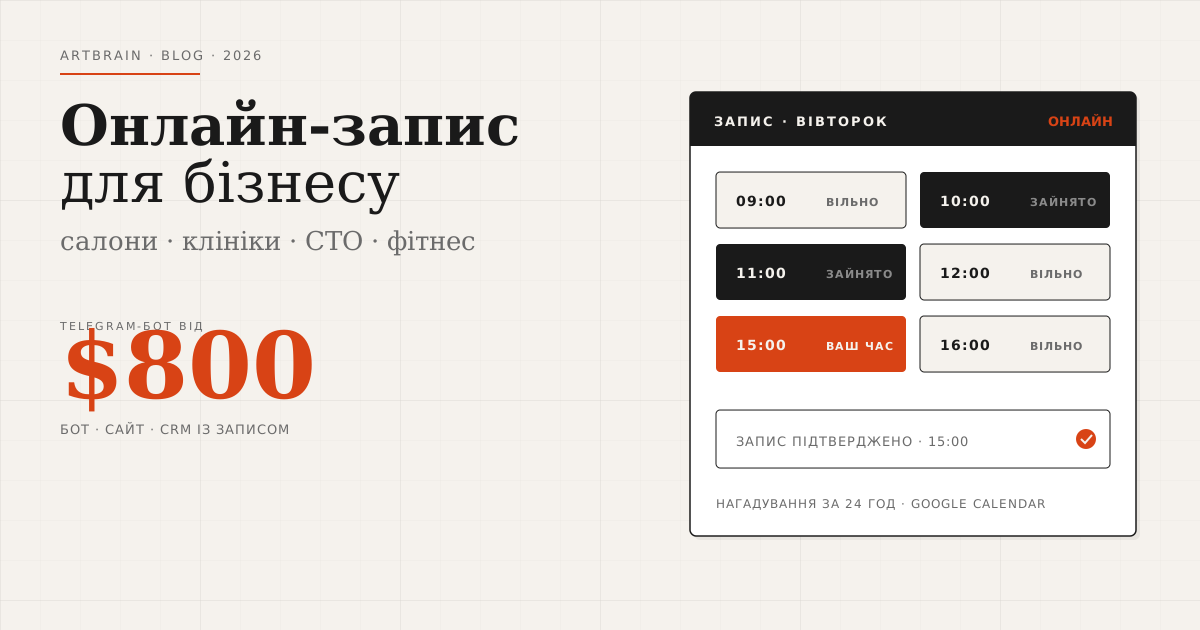
Under the hood it usually includes: a schedule of specialists or services, slot limits by time and capacity, a selection form or buttons, and some confirmation method — an SMS, a Telegram message or an email. There may be a Google Calendar sync so the specialist sees bookings on their phone. There may be an automatic reminder to the client the day before.
Depending on scale this is either a simple Telegram bot, a dedicated web page, or a CRM module with a full client database and analytics.
Who actually needs this
There are a few business types where online booking solves a real daily problem.
Beauty salons, barbershops, studios. A specialist’s time is the main resource. If a client cannot book at 10 PM when they finally pick up their phone, they will message a competitor. A bot or a site form takes bookings around the clock.
Clinics and medical centres. Privacy matters here too. Nobody wants to read out their medical issue over the phone in a crowded waiting room. Online booking lets patients choose a doctor, time slot and service type on their own.
Auto repair shops. Clients want to arrive at a specific time and not wait. If the shop shows real available slots — not "try coming in the morning" — trust goes up.
Fitness clubs and studios. Group classes have a fixed capacity. Online booking lets you manage fill rates: the trainer knows attendance in advance, and clients know their spot is guaranteed.
Tutors, coaches, lawyers. Anyone who sells their time in slots can replace "message me" with a proper booking form.
Off-the-shelf subscription service or your own system
There is no single right answer. There are situations where a subscription makes sense and situations where it will become a headache within six months.
Ready-made booking services with monthly subscriptions offer a fast start. You can usually have a basic page with a form running in a few hours. You pay monthly; updates and hosting are included. But there are trade-offs: the subscription price grows with the number of specialists or locations. Your client data lives on the provider’s servers. Customisation is limited to what the platform allows. If it shuts down or changes its terms, you have to migrate.
A custom system costs more upfront, but once it is live there are no monthly fees per "active specialist". The business logic is entirely yours — you decide how booking works, what the constraints are, what the client confirmation looks like. The data stays with you.
| Parameter | SaaS subscription | Custom system |
|---|---|---|
| Time to launch | Fast, a few hours | From a few weeks of development |
| Entry cost | Low (monthly subscription) | From $300 (bot) / from $2,000 (web) |
| Long-term cost | Accumulates, grows with scale | No per-user licence fee; hosting, support and services are separate |
| Customisation | Limited by the platform | Full, tailored to your processes |
| Client data | On the provider’s servers | On your server |
| Integrations | Only platform-supported ones | Any: CRM, Google Calendar, Telegram |
If a business is just starting out and needs a minimum viable setup, a subscription is perfectly reasonable. If you already have several specialists, a client base and specific processes, custom development is worth considering.
Three ways to build online booking
Telegram booking bot — from $300
The fastest option. The client messages the bot, selects a service, specialist, date and time — and receives confirmation. The administrator or specialist sees the booking in a Telegram group or admin bot.
A good fit for barbershops, nail studios, independent cosmetologists — businesses where clients are already in Telegram and the booking volume is manageable. The bot can sync with Google Calendar so the specialist sees bookings on their phone.
More on bot development: chatbots and Telegram bots.
Booking module on a website or standalone web system — from $2,000
If you already have a website or are planning one, booking can be built right into it. The client opens a page, sees the schedule and available slots, selects one and leaves their contact details. No additional apps required.
This approach works well for fitness clubs, clinics and auto shops. You can display trainer or doctor schedules, manage capacity for group classes, and send reminders. This is exactly what we built for Safari Fitness club network: group class pages, trainer schedules and a booking form — all fully responsive on mobile.
CRM with built-in booking — from $3,000
The most complete option. Online booking becomes part of a larger system: client database, reminders, full visit history, workload analytics by specialist. A manager sees not just "who is booked" but also what services the client used before, whether there were no-shows, and which services are most popular.
Suited to multi-location businesses with larger teams where consolidated reporting matters. More on CRM development.
What is included in development
Regardless of the option — bot, web module or CRM — there are core things we cover in every booking project.
- Schedule and slots. Working hours, breaks, per-service time intervals. If a haircut takes 40 minutes, the system will not place the next client any sooner than 40 minutes later.
- Capacity limits. For group classes — a maximum number of participants. Clients see real availability, not "there might be spots".
- Client reminders. Automatic Telegram or email notification 24 hours or one hour before the appointment. A small thing that makes a difference.
- Google Calendar integration. The specialist or doctor sees bookings on their phone, receives notifications and can manage the schedule in a familiar interface.
- Client database (CRM option). Name, contacts, service, date, notes. Next visit you do not need to ask whether they have been before and what they had done.
To estimate a specific project we need to understand: how many specialists or services, whether there are multiple locations, whether a client database is needed or just booking, and what platform — Telegram, a website or a new system from scratch.
Case study: online booking for a fitness club network
When Safari Fitness, a Kharkiv fitness club network, came to us, one of the goals was to make the schedule and booking experience smooth on mobile. Club members wanted to see which classes were on that evening, who was leading them and whether there were still spots available.
We built group class pages with a day-of-week schedule, individual trainer pages and an online booking form. All of these pages work fully on mobile devices — without any feature loss compared to desktop. Full project details: Safari Fitness club network case study.
Similar tasks come up for any service business that works on a schedule. The difference is in scale and specifics: one specialist can manage with a bot, a multi-location network needs something more substantial.
If you want to work out which option fits your business, get in touch. We will walk through the details together and give you a real solution with a real price.
FAQ
How much does an online booking system cost?
The price depends on scope, integrations and timeline. We prepare an exact estimate after a free review of your task.
What is better: a ready-made booking service or a custom system?
A ready-made SaaS service is cheaper to start and launches in hours, but the subscription cost grows with the number of specialists and client data is stored on third-party servers. A custom system costs more upfront but has no per-specialist fee (hosting and support are paid separately), full customisation to your processes and data on your own server.
Can online booking be done through a Telegram bot?
Yes. The client messages the bot, selects a service, specialist, date and time, then receives confirmation. The administrator or specialist sees the booking in a Telegram group or admin bot, and the bot can be integrated with Google Calendar if needed.
Does online booking integrate with a CRM?
Yes. In a CRM setup, online booking works with a client database, reminders, visit history and analytics. The manager sees not only the booking, but also the client's previous services, missed appointments and popular services.