What is ERP and How It Transforms Enterprise
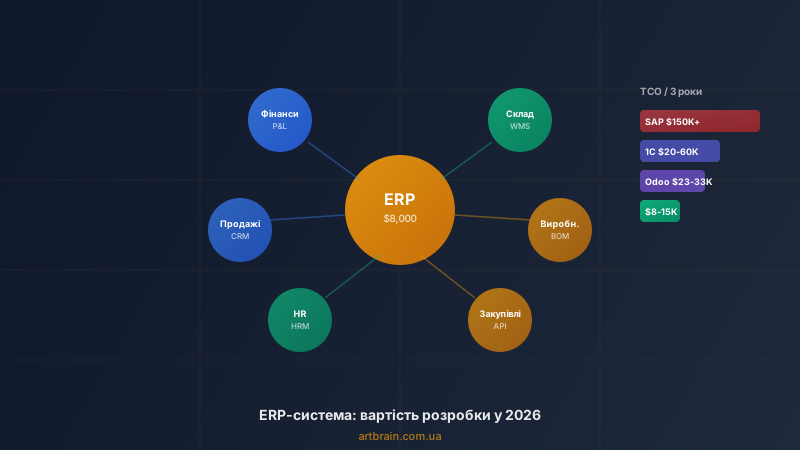
ERP (Enterprise Resource Planning) is a comprehensive system that unifies finance, production, warehouse, sales, procurement and HR into a single platform.
Who Needs an ERP System
ERP is essential for enterprises where manual management creates chaos:
- Manufacturing enterprises: production planning, raw material tracking, quality control – when Excel can no longer handle hundreds of SKUs
- Trading companies: warehouse management, procurement, multi-channel sales simultaneously
- Service companies: project accounting, resource allocation, financials – from estimation to signed completion act
- Distributors: logistics, warehouse, order management, regional delivery routing
- Agriculture & food industry: batch tracking, expiration dates, quality control at every stage
Core ERP Modules
Finance & Accounting
Budgeting, invoicing, payments, accounts receivable and payable, P&L statements. Automatic tax document generation, bank statement import, real-time cash flow monitoring.
Production Management
Bill of materials (BOM), manufacturing orders, capacity planning, quality control. Tracking every batch from raw material to finished product, cost calculation, waste accounting.
Warehouse & Logistics
Goods receiving, shipping, inventory counting, minimum stock levels. Automatic reorder on minimum threshold, serial and batch tracking, warehouse zoning.
Procurement
Purchase requests, supplier comparison, contracts, delivery schedules. Automatic order generation based on production needs and minimum inventory levels.
Sales & CRM
Orders, quotations, sales funnel, analytics. Integration with online store and marketplaces – all orders in one system. If you need a standalone customer management system, we also develop CRM systems with ERP integration.
HR & Payroll
Staffing, time tracking, payroll calculation, leave management – when an HR module is needed as part of the overall system. For companies with advanced HR needs, we recommend a dedicated HRM system with recruiting, KPI, and onboarding modules.
Custom ERP vs Off-the-Shelf
Off-the-shelf ERP platforms and boxed solutions require large-scale implementation, licensing and adaptation to your processes. A custom ERP from Artbrain is built the other way – starting from your actual processes:
- You pay only for modules you actually use
- Interface designed for your roles – CEO, accountant, warehouse worker each see different dashboards
- Integration with existing systems – accounting software, banks, logistics operators, marketplaces
- Incremental development – start with finance and warehouse, add production later
For companies with large warehouses, ERP is effectively complemented by a specialized WMS system that provides addressable storage and order picking optimization.
ERP Implementation Steps
- Business process audit – interviews with each department, analyzing data flows and document workflows
- System architecture – selecting modules, designing connections between them, data model
- Development – building the ERP for your specific processes and industry
- Data migration – importing master data, inventory balances, financial history, counterparties
- Integrations – banking, e-commerce, logistics providers, government reporting
- Role-based training – separate sessions for each department based on their tasks
- Phased rollout – go-live by department, parallel running with legacy systems, full transition
For detailed pricing, comparison with off-the-shelf ERP platforms, module-by-module cost breakdown – read our article How Much Does an ERP System Cost in 2026.