You run an online store with a couple thousand products, orders are processed manually, and the operator issues Nova Poshta waybills by clicking around the NP website. Sound familiar? It is the story of most Ukrainian e-commerce stores, until they grow and break. Here is what integrations a Ukrainian online store actually needs in 2026, what each one costs (based on our estimates for online store development), and how the Nova Poshta API is wired up correctly, using real code from our own Airstep store. No fluff, no doc-copy, real prices.
Which integrations a 2026 e-commerce store needs — short price list
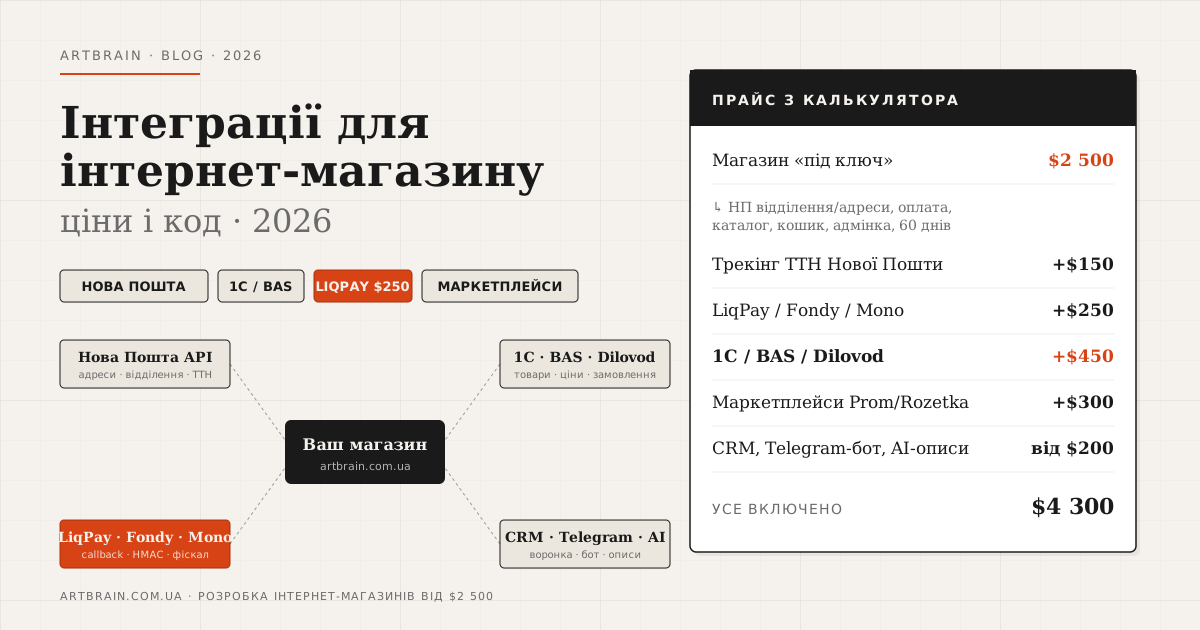
The prices below are examples for our online store development projects. The base "turnkey" store costs $2,500 and already includes the catalog, cart, checkout, customer cabinet, reviews, wishlist, promo codes, stock, admin panel, and basic Nova Poshta integration (city/branch picker in the order form). Everything else – separate modules at fixed prices:
| Integration | Price | What it does |
|---|---|---|
| Nova Poshta — branches/addresses | included in $2,500 | City and branch search in checkout form |
| Waybill tracking (order status) | included in the base price | Customer sees parcel status in their cabinet |
| UkrPoshta / Justin | +$200 | Alternative delivery carriers |
| Online payments (LiqPay/Fondy/Monobank) | +$250 | Cards, Apple Pay/Google Pay via LiqPay |
| Monobank installment payments | +$150 | 3, 6, 12 monthly installments, no interest |
| Apple Pay / Google Pay (separate button) | +$100 | 1-click mobile checkout |
| 1C / BAS / Dilovod | +$450 | Sync of products, stock, prices, orders |
| Marketplaces / Google Shopping | +$300 | Automatic catalog export |
| CRM integration | included in the base price | Orders flow into the sales funnel automatically |
| Telegram order bot | +$300 | Accept orders directly in Telegram |
| SMS notifications (TurboSMS) | +$150 | Auto-SMS to customer after payment |
| Email campaigns (SendPulse / Mailchimp) | +$200 | Trigger emails + promo broadcasts |
| AI product descriptions | +$200 | Auto SEO descriptions via Claude |
Development prices are one-time. Hosting, support and connected services are paid separately. We agree the exact cost of your modules after a short review of the task.
Integrations built into the store, not bolted on
Turnkey online store development starts at $2500. Nova Poshta, payment and accounting integrations can be part of the agreed scope; the exact scope is set after the brief. The Airstep online store has 6,700+ products and automatically imports its catalogue from XML feeds supplied by four suppliers.
Estimate my storeNova Poshta: API, gotchas, and real Airstep code
Nova Poshta is the most common integration in Ukrainian e-commerce. In the base $2,500 store price we always include city and branch/parcel-locker search in the checkout form. Waybill tracking is included too; alternative carriers (UkrPoshta/Justin) are an extra $200.
What the Nova Poshta API gives you
The API is free, you get a key from your NP cabinet in 5 minutes. Limit — 10 requests per second per key, plenty even for stores with 100+ orders per day.
Real code from our Airstep store
Here is the request structure we use in Airstep on the backend (Django) for city autocomplete in the checkout form:
POST https://api.novaposhta.ua/v2.0/json/

{
  "apiKey": "<NOVA_POSHTA_API_KEY>",
  "modelName": "Address",
  "calledMethod": "searchSettlements",
  "methodProperties": {
    "CityName": "Khar",
    "Limit": "20",
    "Page": "1"
  }
}
The response contains a list with a DeliveryCity field (a unique city ref). We store it on the order and later use it to fetch warehouses:
{
  "modelName": "Address",
  "calledMethod": "getWarehouses",
  "methodProperties": {
    "CityRef": "8d5a980d-391c-11dd-90d9-001a92567626",
    "Limit": "50",
    "Language": "UA"
  }
}
Gotchas we stepped on
FindByString is case-sensitive. Sounds trivial, killed half a day of debugging. If you pass "branch №5" in lowercase you get an empty array. You need "Branch №5" capitalized. Workaround:
props['FindByString'] = search[0].upper() + search[1:]Cache results. Hitting the API on every autocomplete keystroke means you DDoS NP with your own users. We cache search results in Redis for 30 minutes under np:cities:<query>.
Rate-limit your own endpoint. Bots and autocomplete-abusers can drain your full quota. We rate-limit our proxy view to 60 requests/min per IP via django-ratelimit.
Parcel lockers are not "branches". If you filter by CategoryOfWarehouse=Branch you cut off a convenient pickup option. Fetch everything and group in UI by TypeOfWarehouse.
Waybills from admin
Waybill tracking is included in the base store price. The manager does not have to retype shipment numbers manually: a waybill is created via InternetDocument.save directly from the orders list, the tracking number is automatically sent to the customer via SMS or Telegram.
One important detail: for cash on delivery you must pass BackwardDeliveryData with PayerType: "Recipient" and AfterpaymentOnGoodsCost. Forget it and the parcel ships, but NP does not collect the money — you ship goods for free. The most common bug we see in DIY integrations.
1C / BAS / Dilovod — $450 for two-way exchange
For many Ukrainian stores 1C (or BAS, Dilovod) is the live accounting system: bookkeeping, warehouse, prices, VAT invoices. Integration with the site is a two-way exchange: 1C → site (products, prices, stock) and site → 1C (orders, new customers).
Based on our estimates for online store development, this option costs $450 and includes sync of products, stock, prices and orders. The actual implementation depends on your 1C/BAS configuration: if you already have a 1C developer with a working exchange – we plug into our format; if there is no exchange – we build the intermediate layer.
One important principle: the site must not query the 1C database directly. 1C is a monolith with its own logic, configurations get updated regularly, and direct SQL access from an external web server is a critical security hole. The right approach is exchange through an intermediate layer (XML/JSON exchange, REST API, or buffer tables) so the 1C developer and the web developer do not block each other.
For systems without 1C, KeyCRM, SalesDrive, RemOnline, Dilovod already have proper REST APIs, so site integration is simpler than with 1C. CRM integration is included in the base store price.
Payment systems: LiqPay, Fondy, Stripe, Monobank — $250
On our e-commerce development page the default payment stack is LiqPay, Fondy, Stripe. Based on our estimates for online store development, connecting any of these (plus Monobank Acquiring) costs a one-time $250. Optional: Monobank installment payments +$150, dedicated Apple Pay / Google Pay button +$100.
What matters technically
All modern Ukrainian payment systems (LiqPay, Fondy, WayForPay, Monobank Acquiring) follow a similar pattern:
- Customer clicks "Pay" on the site.
- Backend builds a signed form with order data and an HMAC signature.
- Customer is redirected to the gateway, completes the payment.
- Server-to-server callback arrives at your URL with the same signature — you verify it and set the order to "paid".
- Separately the customer is redirected to your result_url — UI only.
The most common mistake in DIY integrations: marking an order as paid when the customer is redirected back. Classic XSS vector — feed the victim a URL with a stranger's order ID and you mark it as paid. Payment is confirmed only by a signed server-to-server callback with your privateKey.
Second mistake: non-unique order_id. If the customer clicks "Pay" twice, you end up with two charges on the same order. Use order_id = "{order.pk}-{timestamp}" and de-duplicate in the callback.
Other useful store modules
Beyond Nova Poshta, 1C, and payments — there are a few smaller but very useful modules. Bundling them up front is significantly cheaper than bolting them on later as separate contracts:
- Marketplaces / Google Shopping — $300. Automatic catalog export. If you still sell only through a marketplace, read why your own store can be more profitable in 2026.
- CRM integration is included in the base store price. KeyCRM, SalesDrive, or a custom CRM system. Site orders flow into the sales funnel automatically.
- Telegram order bot — $300. Takes orders right inside Telegram, hits the same backend. Details — Telegram bot development.
- SMS notifications (TurboSMS) — $150. Automatic SMS to the customer: "order received", "shipped, waybill №…", "delivered". Cuts manager workload.
- Email campaigns (SendPulse / Mailchimp) — $200. Trigger emails (abandoned cart, repeat purchase) plus promo broadcasts.
- AI product descriptions — $200. Auto SEO descriptions via Claude. We have a real case where we generated 4,000 descriptions for $20 on our own Airstep store.
If you already run a real warehouse with serious logistics (1000+ SKUs, multiple zones, pick lists) — that is no longer "an integration", consider a WMS system as a separate product.
How much does a "fully integrated" store cost
Base: $2,500 for a store with Nova Poshta branch selection and CRM integration. Online payment integration costs an additional $250. The total then depends on the modules you add:
- Starter: $2,500 — store with base integrations, ready to take orders
- +1C + marketplaces: $2,500 + $450 + $300 = $3,250
- Module bundle (1C + marketplaces + CRM + Telegram bot + SMS + email + AI descriptions): $4,100
We agree the exact price of your options after a short review of the task. Development timeline: 4–8 weeks depending on scope.
How we work
At Artbrain we have been building integrations since 2018. We run our own live store Airstep with 6,700+ products, where the Nova Poshta code, AI descriptions, supplier sync and other pieces work in production every day — so this is not "YouTube theory" but practice-tested experience.
- Submit a request via the contacts page or the online store development page, and we will call you back.
- We discuss your processes and build a technical spec with line-item pricing.
- 50/50 payment: first half upfront, second after a working demo.
- Release + 60 days of free post-launch support (included in the store price).
Related reading: platform or custom development · Airstep development case · AI product descriptions for $20 · own store vs marketplace · e-commerce development · portfolio.
FAQ
How much does Nova Poshta integration cost for an online store?
The price depends on scope, integrations and timeline. We prepare an exact estimate after a free review of your task.
How much does 1C / BAS / Dilovod integration cost?
The price depends on scope, integrations and timeline. We prepare an exact estimate after a free review of your task.
Which payment systems do you connect to the online store?
We integrate LiqPay, Fondy, Stripe, and Monobank Acquiring — the default payment stack for Ukrainian e-commerce. Connecting any of these costs a one-time $250. We estimate the cost after a free review of your task and agree on scope, timeline and price before work starts. Optional add-ons: Monobank installment payments +$150, a dedicated Apple Pay / Google Pay button +$100. We implement the correct server-to-server callback flow with signature verification — avoiding the vulnerabilities common in DIY integrations that mark orders as paid based on the customer redirect.
What other integrations can you connect?
Beyond Nova Poshta, 1C, and payments, we offer the following modules: marketplace export to Prom/Rozetka/Google Shopping ($300), CRM integration (included in the base price), Telegram order bot ($300), SMS notifications via TurboSMS ($150), email campaigns via SendPulse/Mailchimp ($200), AI product descriptions via Claude ($200), UkrPoshta/Justin ($200), multi-language ($250), multi-currency ($200). Development prices are one-time. Hosting, support and connected services are paid separately.
How much does an online store with all integrations cost?
The price depends on scope, integrations and timeline. We prepare an exact estimate after a free review of your task.