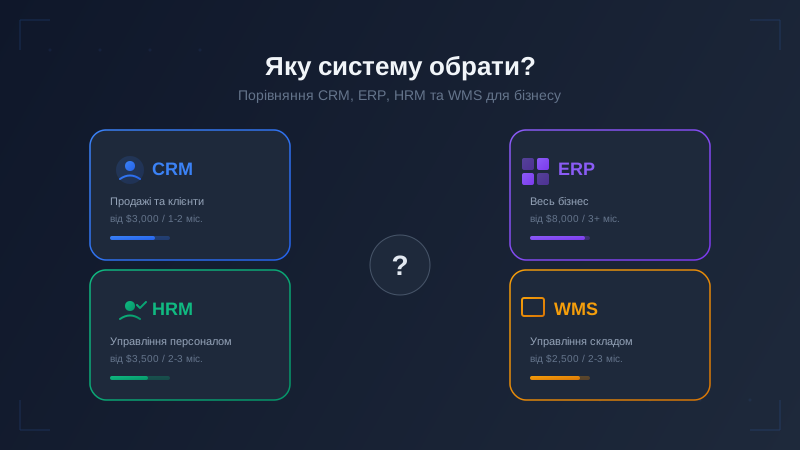
Business Automation – When Excel Can't Keep Up Anymore
Business grows, and so does chaos: leads get lost, managers forget to call back, inventory doesn't match, and you spend hours on manual Excel reports. Business systems bring order: CRM for sales, ERP for management, WMS for warehouse, HRM for team.
We develop custom systems for your processes – you don't adapt to software, software adapts to you.
CRM System – The Heart of Sales
CRM (Customer Relationship Management) – a system for managing customer relationships. Simply put: all your clients, deals, and communications in one place.
What CRM provides:
- Unified customer database – history of all contacts, deals, calls
- Sales pipeline – see what stage each deal is at
- Automatic reminders – system won't let you forget to call back
- Analytics – who sells most, where clients come from
- Integrations – telephony, messengers, email, website – all in one window
Who needs CRM: sales teams, service companies, agencies, anyone working with clients.
ERP System – Managing the Entire Business
ERP (Enterprise Resource Planning) – an enterprise resource planning system. It's the company's "brain" that unites all departments.
ERP Modules:
- Finance – budgets, expenses, profits, reports
- Procurement – suppliers, orders, contracts
- Manufacturing – planning, quality control, cost calculation
- Warehouse – inventory, transfers, stocktaking
- Sales – orders, invoices, shipping
- HR – employees, salaries, vacations
Who needs ERP: manufacturing, distributors, companies with 20+ employees where many processes need coordination.
WMS System – Warehouse Order
WMS (Warehouse Management System) – a warehouse management system. Knows where everything is, when to order, and what's in stock.
WMS Features:
- Location-based storage – each product has its "address" in the warehouse
- Receiving & shipping – barcode scanning, automatic documents
- Inventory – quick stock checks without stopping work
- FIFO/LIFO – expiration date control, product rotation
- Reports – turnover, inventory, ABC analysis
Who needs WMS: e-commerce stores, distributors, manufacturing, anyone with 100+ SKU warehouse.
HRM System – Team Management
HRM (Human Resource Management) – a personnel management system. From hiring to termination – all HR processes in one place. We've shipped enterprise HRM platforms with 17 modules and 93K LOC.
HRM Capabilities:
- Employee database – contacts, documents, history
- Time tracking – timesheets, schedules, overtime
- Leave & sick days – requests, balances, calendar
- Recruiting – vacancies, candidates, hiring pipeline
- Performance evaluation – KPIs, 360-degree feedback
Who needs HRM: companies with 15+ employees where HR spends too much time on routine.
Custom System vs Off-the-Shelf Solution
There are ready-made boxed CRM/ERP solutions. According to Gartner, more companies are choosing custom development. Why?
Off-the-shelf solutions:
- Quick start (days, not months)
- Lower initial cost
- But: monthly fees, limited customization, your data on someone else's servers
Custom development:
- System for your processes, not the other way around
- One-time payment – no monthly fees
- Full control – code is yours, data is yours
- Integrations with any services
- Unlimited scaling
Our recommendation: if your business is unique or you've outgrown ready solutions – go custom. If standard processes and limited budget – off-the-shelf.
Signs Your Business Needs a System
- Managers track clients in Excel or notebooks
- No unified database – everyone has their own "spreadsheet"
- Leads get lost, clients don't get callbacks
- Management can't see the real picture – only "approximately"
- Lots of manual work that could be automated
- Employees duplicate data in multiple places
- Warehouse "lives its own life" – unclear what's available
If you recognized at least 3 points – it's time to automate. Or jump straight to comprehensive automation — CRM+ERP+site+integrations in one bundle.