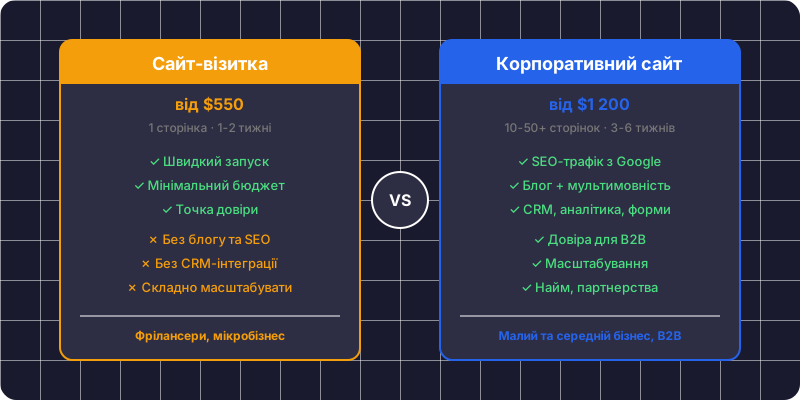
Short answer: if your company has more than 5 employees, works with B2B clients, or plans to scale – you need a custom corporate website. If you're a freelancer, micro-business, or just testing a niche – a business card site (landing page) will do. Price difference: from $550 for a card site vs. from $1,200 for a corporate website. But the difference in results is much bigger. In 8 years at Artbrain, we've built dozens of both and seen businesses outgrow card sites in 6–12 months, spending twice as much on rebuilds. This article is an honest comparison without marketing fluff: what's included in each type, what it really costs, and how to figure out what you need – so you don't pay twice.
What Is a Business Card Website and When Is It Enough
A business card site (also known as a landing page) is a single page with multiple sections: about the company, services, benefits, testimonials, and a contact form. It's the digital equivalent of a paper business card – minimal text, maximum specifics. All the information is on one page that the visitor scrolls from top to bottom.
What's Typically Included
- Hero section – who you are, what you do, main call to action (CTA)
- About the company – brief: experience, values, team
- Services/products – list with short descriptions
- Benefits – why choose you
- Testimonials – social proof
- Contact form – phone, email, feedback form
All on a single page. No separate sections, no blog, no catalog.
Who It's For
- Freelancers and self-employed (photographers, designers, consultants)
- Local businesses with 1–5 employees (hair salon, car wash, cafe)
- Startups testing a niche without committing to a full website
- Companies where most clients come from word-of-mouth or Instagram
- New product or promotion launch – need one high-converting page
A business card site works as a trust checkpoint: a client Googles your name, sees your website, confirms you exist – and calls. It's the minimum viable website. No more, no less.
What Is a Corporate Website and Why Businesses Need One
A corporate website is a full-featured digital platform with 10–50+ pages. It doesn't just \"represent\" a business – it works for it: generating leads, building trust, attracting partners, and helping with hiring.
Typical Corporate Website Structure
- Homepage with USP – unique selling proposition, key metrics, CTA
- About the company – history, mission, team with photos, certifications
- Services/products – dedicated page for each service with details
- Portfolio/case studies – detailed project descriptions with results
- Blog – articles, company news, expert content
- Contacts – form, map, multiple ways to reach out
- Multilingual – Ukrainian + English (for international clients)
- Integrations – CRM, analytics, chatbots, payment systems
What a Corporate Site Does That a Card Site Can't
- SEO traffic – blog and individual service pages rank for dozens of queries
- Lead automation – forms, calculators, online booking
- B2B trust – large companies won't work with a business that doesn't have a proper website
- Recruiting – job listings, company culture page
- Scalability – add new services, markets, languages without rebuilding from scratch
Comparison Table: Card Site vs Corporate Website
| Criteria | Business Card Site | Corporate Website |
|---|---|---|
| Format | 1 page with sections | 10–50+ separate pages |
| Development cost | from $550 | from $1,200 |
| Development time | 1–2 weeks | 3–6 weeks |
| Blog | No | Yes |
| SEO potential | Minimal (5–10 queries) | High (50–500+ queries) |
| Multilingual | Rarely | Standard (UK + EN) |
| CRM integration | No | Yes |
| Online ordering | Contact form only | Forms, calculators, chatbots |
| Best for | Micro-business, freelancers | Small & medium business, B2B |
| Support & growth | Minimal | Regular updates, new sections |
Real Costs in 2026
We publish our prices because we believe clients should understand the budget before the first call. Here are real Artbrain figures as of April 2026:
Business Card Site (Landing Page) – from $550
- 1 page with sections (hero, services, benefits, testimonials, contacts)
- Responsive design (mobile + desktop)
- Contact form with Telegram notifications
- Basic SEO optimization (title, description, structure)
- SSL certificate, hosting consultation
- Timeline: 1–2 weeks
Corporate Website – from $1,200
- 10–20+ pages with custom design
- Blog with admin panel
- Multilingual (Ukrainian + English)
- SEO optimization for every page
- Google Analytics, CRM integration
- Forms, calculators, callback widgets
- Structured data (Schema.org) for Google
- Timeline: 3–6 weeks
Why is the difference \"only\" $650? Because the main cost is in design, planning, and SEO foundation. Additional pages cost less than the first. That's why it's better to build a corporate site right away than to rebuild a card site a year later – the rebuild costs 1.5–2x more than building from scratch.
Calculate your project cost with our online calculator – it factors in page count, languages, integrations, and extra features.
5 Signs You Need a Corporate Website, Not a Card Site
If at least 3 out of 5 apply to you, a card site is no longer enough:
- You offer more than one service or direction. A card site doesn't give room for detailed service descriptions. And Google won't rank a page where everything is mixed together.
- You work with B2B clients. A procurement manager at a large company will open your site and decide in 10 seconds whether to work with you. A card site looks unserious for B2B.
- You need leads from Google. SEO works through content. No blog, no individual service pages – no search traffic. A card site physically cannot rank for dozens of queries.
- You plan to hire. Candidates check the employer's website. A careers section, team page, and case studies create the image of a company people want to join.
- Your competitors already have a corporate site. If a client compares you with a competitor that has a full website with case studies, blog, and reviews – and you have 3 pages – the choice is obvious.
Do You Even Need a Website at All?
An honest question we ask some clients during consultation. Because sometimes the answer really is \"not yet.\"
Instagram Instead of a Website?
For some niches, Instagram is the main sales channel: beauty, handmade, food. But there are problems:
- You depend on the algorithm – Instagram changes its feed, and your posts reach 5% of followers
- Zero B2B trust – no serious company will order from a business without a website
- No analytics – you don't know who visits, where they come from, what they view
Our recommendation: Instagram is a great supplementary channel. But not a replacement for a website if you want to grow.
Marketplace Instead of a Website?
Marketplaces work, but you pay commission on every sale and don't build your own customer base. Fine for starting out. Limiting for scaling.
Real Case: How a Business Outgrew Its Card Site in 8 Months
A business owner in industrial equipment maintenance came to us. Asked for a 4-page card site: home, services, about, contacts. Minimal budget.
We delivered. The site worked, leads came in – 2–3 per month via word-of-mouth and direct URL. But 8 months later, the client returned:
- \"We need a separate section for each equipment type\" – 6 new pages
- \"We want a blog with technical articles\" – competitors started ranking higher
- \"We need an English version\" – inquiries from foreign clients appeared
- \"We need CRM integration\" – managers were losing leads
This is a typical story. We don't say \"always go for the expensive option.\" We say: plan 2 years ahead. If you see growth – invest in a corporate website now.
How to Choose: Step by Step
- Define your target audience. B2C with a local radius – a card site may suffice. B2B or multiple cities – corporate.
- Count your services. 1–3 services – card site. 4+ with different target audiences – corporate.
- Evaluate competitors. Open 5 competitor websites. If they have corporate sites – you need the same or better.
- Think about SEO. Need traffic from Google? Without a blog and individual service pages – won't happen.
- Plan for 2 years. Planning new services, hiring, multilingual? Go corporate from the start.
What's Next
If you've read this far – you're already serious about your choice. Here are your next steps:
- Calculate your budget – use our website cost calculator
- See examples – our portfolio includes both card sites and corporate websites
- Get a consultation – contact us, tell us about your business, and we'll honestly tell you what you need
At Artbrain, we've been working since 2018 and completed 30+ projects – from landing page development to enterprise HRM systems (17 modules, 93K LOC). We don't upsell. We help you choose what will actually work for your business.
Also read: How Much Does a Website Cost in 2026 and 7 Reasons to Order Development from Artbrain.
FAQ
What is the difference between a corporate website and a business card site?
A business card site (landing page) is a single page with sections: about the company, services, benefits, testimonials and contact form. A corporate website is 10-50+ separate pages with a blog, detailed service pages, multilingual support, CRM integration and SEO optimization. The key difference: a corporate site generates traffic from Google and works as a sales tool, while a card site only confirms your business exists.
How much does a corporate website cost in 2026?
The price depends on scope, integrations and timeline. We prepare an exact estimate after a free review of your task.
When does a business need a corporate site instead of a card site?
You need a corporate website if: you have more than 3 services or directions, you work with B2B clients, you need traffic from Google, you plan to hire employees, or your competitors already have full websites. If at least 3 out of 5 apply – a card site is no longer enough.
Can I later convert a business card site into a corporate one?
Yes, but rebuilding is usually more complex than planning a corporate website from the start. It includes changing architecture, migrating content and setting up SEO. If you plan to grow, it is better to design the corporate-site structure early.
Can Instagram replace a website for business?
Instagram is a great supplementary channel but not a website replacement. 68% of online sessions start with a Google search, and without a site you won't be found there. Instagram also lacks analytics, you depend on the algorithm (posts reach 5-10% of followers), and for B2B clients a business without a website looks unprofessional.